
Things to Know About the Orthodox Church
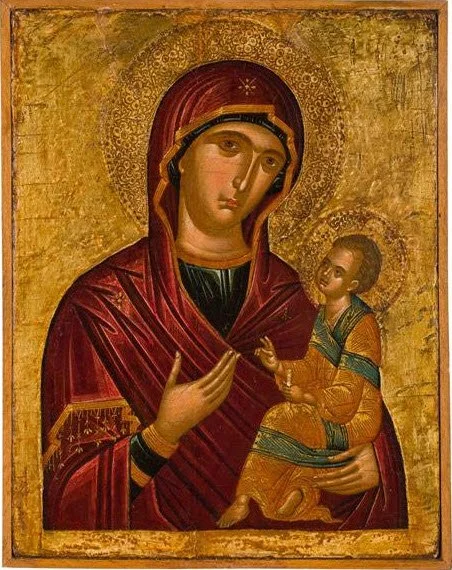
1) The proper place of the Virgin Mary: The Orthodox Church has a special title for her, calling her the “Mother of God” because we believe that Jesus Christ, the second person of the Holy Trinity is God. Thus, the child to Whom Mary gave birth is God. She is not the originator of God, as He existed before time. Holy Tradition demonstrates that since the early days of the Christian Church the faithful called upon her for aid in trials and sorrows.
Orthodox Christians proclaim through the divine services that God alone is the only One to Whom worship is due.
2) Veneration of icons: The Orthodox Church is careful and precise in its terminology. The term “worship” is offered to God alone. The Church uses the word “venerate” as a way of offering praise and honor to the Saints.
Icons are like windows giving us a glimpse into heaven. We can also think of them as we do photos of loved ones. In our own families we keep the pictures of our loved ones who have departed this life to preserve their memory and to celebrate them. We also keep the pictures of the members of our Christian family who have led exemplary lives.
Additionally, icons have adorned Churches since the earliest days of Christianity and sacred images have also been found in ancient synagogues - see the discoveries at Dura Europa.
3) We don’t worship saints: The Orthodox Church teaches her children the importance of offering prayer to the righteous who have been well-pleasing to God. The Church does not “make” Saints but rather confirms what God has already shown through miracles and wonders. To these righteous ones, the Church directs us to call upon them for prayers and aid in time of need. The Church uses to verb “veneration” to explain the prayers and attitude we have concerning Saints. Further, the Church recognizes the heavenly Church, the Church Triumphant, to which the righteous are members. The earthly Church is called the Church Militant.
4) Concerning Tradition: The Church existed before the Bible was written. The early Church communities had different books of the New Testament but the collection of books that would become the New Testament was not agreed upon until the late 4th century.
It was holy tradition that helped the Church to decide what was canonical scripture (of proven authorship and salvific in its teachings).
When we speak about tradition, we refer to Holy Tradition, that is, the teachings that were handed down to us from the Apostles and their Disciples. It was this very tradition of the Church that gave us the New Testament. The holy Tradition provided other things such as how to keep order in the Church, order of worship, as well as many other things. The Church has a vast treasury of writings from the earliest days of Christianity that verify the teachings of the Church. See the writings of Saints Ignatius of Antioch, Polycarp of Smyrna, Clement of Rome, for example, for their teachings on such things as the Eucharist, Baptism, hierarchy and so on.
Remember the teaching of Saint Paul:
“Therefore, brethren, stand fast, and hold the traditions which ye have been taught, whether by word, or our epistle.” 2 Thessalonians 2:15
See also the words of the Apostle Luke 1:3-4:
“It seemed good to me also, having had perfect understanding of all things from the very first, to write unto thee in order, most excellent Theophilus, 4 That thou mightest know the certainty of those things, wherein thou hast been instructed.”
5) Faith vs. Works: Orthodox Christianity is not solely “works” based: It always takes the grace and will of God to bring about our salvation. It is a cooperative effort. We do good works because it is our faith and joy in living Christ-centered lives and the demonstration of our love for God and neighbor. The Church does not hold us accountable to any sort of merit system. The essence of the faith is drawing closer to Christ. The Saviour Himself has taught us the dichotomy of faith and action, for example Prayer and Fasting. Remember the teaching of Saint James, that “Faith without works is dead” cf James 2:18 and 2:26.
6) Constantine did NOT change the Church: Some theorists state the Saint Constantine, (yes the Church numbers him among the Saints) reformed Christianity in some way. These theorists are quick to forget that the Edit of Milan, issued by Saint Constantine, legalized Christianity. Saint Constantine was a defender of Christians both in the Roman Empire and acted on their behalf in the Persian Empire. We can all thank Saint Constantine for the celebration of Christmas. After the legalization of Christianity, he ordered the great Basilica in Bethlehem to built over the place of Jesus’ birth. The Church then composed hymns and services in celebration, thus elevating the place of the commemoration of Christ’s nativity.
It is important to state that prior to Saint Constantine and the First Ecumenical Council, the Church celebrated the Eucharist as the very Body and Blood of Christ. It had a hierarchal structure with Bishops administering local churches. There were local councils that convened to preserve order in the Church, resolve administrative concerns, as well as quell heresy.
These same responsibilities remained after the Saint Constantine and after the First Ecumenical Council. Two important topics addressed were the affirmation of the Christological teaching that Jesus Christ existed before all creation with the Father and the resolution of a common day of Pascha, the day of the Lord’s resurrection.
7) The Orthodox Church is pre-denominational. “Orthodoxy” can be defined as right belief and sees itself as the One, Holy, Catholic, and Apostolic Church. By definition, the Church, the right believing Church was the same Church of the Old Testament. Prophets and Kings. In the New Testament, the preaching of the Prophets was completed with the incarnation of the Lord and Saviour, Jesus Christ. The promises of the Old Testament prophecies found their fulfillment in Christ.
Christ’s Church is not divided. False and erroneous teachings have existed since the dawn of Christianity. These false teachings were addressed by the Church and those who persisted in these erroneous teachings were separated from the Church. See also the teaching of the Lord concerning those who neglect to hear the teaching of the Church, see Matthew 18:15-17.
8) The Orthodox are “Bible believing” Christians. The Orthodox divine services are full of verses from the Bible, both Old and New Testaments. Further, the reading and chanting of Psalms is seen and heard in every Orthodox Service. Each Divine Liturgy consists of a reading from the Epistles, from the Gospels, and the chanting of Psalms. Both Matins and Great Vespers consists of reading and chanting more than 8 Psalms in each service.
In addition, it was the Orthodox Church that decided which books were to be contained in the canonical scripture.
9) Is Orthodox Christianity the same as Roman Catholicism: Both Churches have organized worship, hierarchal structure, and common roots. The life, practice and doctrine of the Roman Catholics and The Orthodox are quite different. The Orthodox view the Pope as the bishop of Rome, not a supreme leader of the entire Church. Over the centuries, differences in core beliefs have crept into the Roman Catholic Church, such as the Filioque, Primacy of the Pope, Papal Infallibility, and doctrine of Original Sin. These teachings were never included in the worship in the Orthodox Church. These teachings began to take hold in the Roman Catholic Church after 1054, which marked the schism between East and West.
10) Jesus Christ, our Lord and Savior, is the head of the Orthodox Church: The Orthodox Church possesses Apostolic Succession, meaning it can trace the lineage of the ordinations of its Bishops all the way back to Christ Himself, His Apostles, and their Disciples with unbroken continuity. Orthodox Christianity is the most historically correct Church.
Orthodoxy is a new way of a Christ-centric life. Belief and adherence is life changing and experiential and not theoretical. It invites us to action. It challenges us to be numbered among the sheep on the Lord’s right hand, not the goats on His left hand, cf. Matthew 25:33-46. One benefits from the amount of effort they extend to firmly root themselves in the faith and way of life. Orthodoxy bids us to follow the Lord’s command to “pick up our Cross daily and follow Him”. In so doing, we are buried with Christ , then resurrected with Him.
Orthodoxy brings true meaning and fulfillment to our lives.